


There was a wonderful article on Slate this week (with YouTube links) entitled "Famous Classical Composers: The Last Piece They Wrote Before They Died." It's not just the usual suspects (Bach, Mozart, etc.), but also Schubert (Der Winterreise), Brahms and Schoenberg. The link (as above) is: http://www.slate.com/articles/arts/music_box/2011/11/famous_classical_composers_the_last_piece_they_wrote_before_they_died_.html
The Mozart is disappointing. It's the Neville Marriner Requiem (sooo sloow), and does not include the last movement Mozart wrote (I believe), which is the Lacrimosa. And if that does not send shivers up your spine, nothing ever will.
Showing posts with label W.A. Mozart. Show all posts
Showing posts with label W.A. Mozart. Show all posts
Thursday, December 1, 2011


Thursday, June 3, 2010
Strays

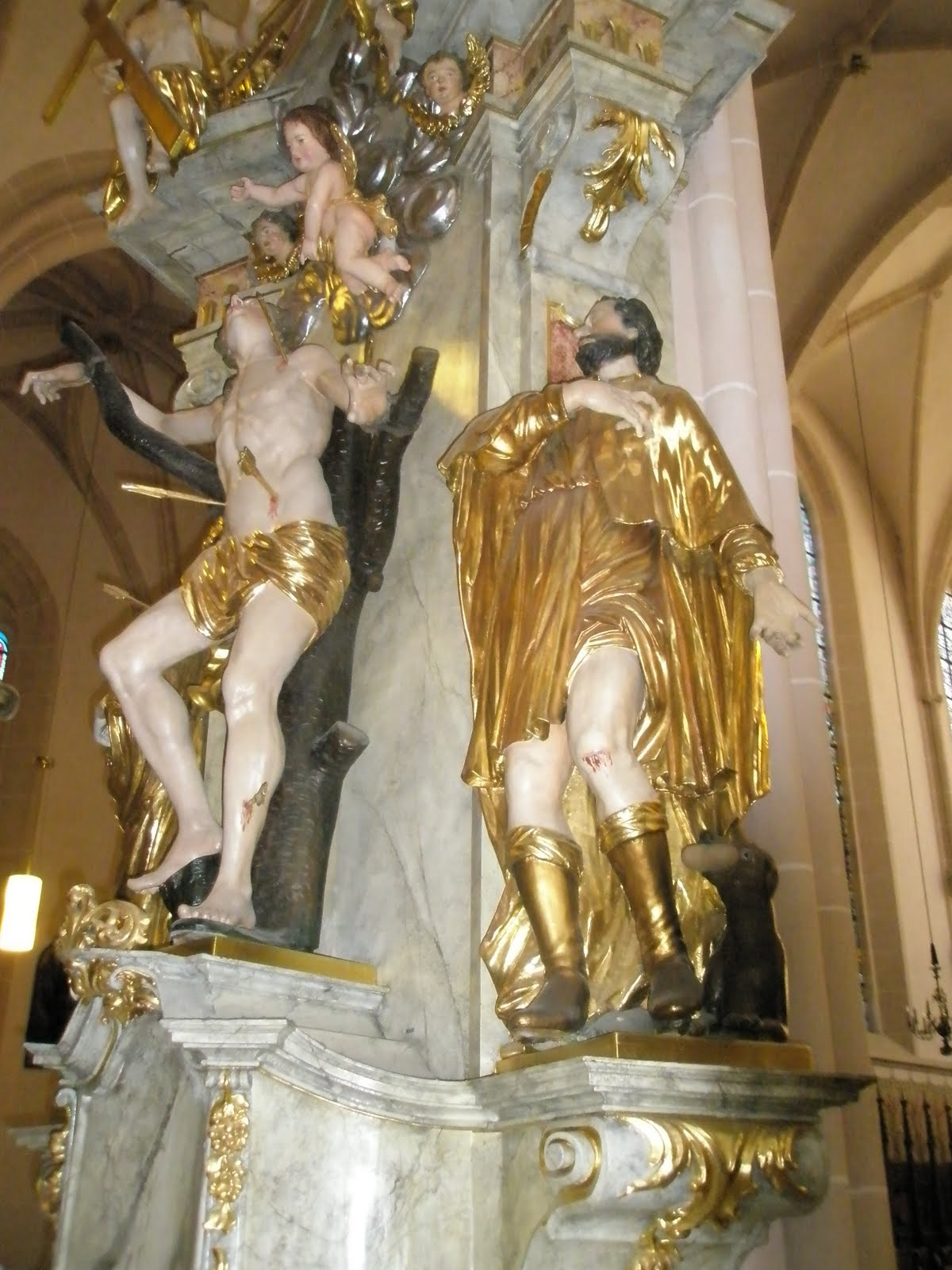
I just found two stray photos of St. Stephen's Church in Baden bei Wien. One is of the baroque-era plague saints (Sebastian and Rocco, note his dog in the lower right), and the other is of the organ that Mozart composed for. Same organ.
Saturday, May 15, 2010
Mozart

Before my trip to Bratislava, I made a list of books to look for about that part of the world. I have done this for all my my trips to Central Europe, so there are books I've already read. Frederic Morton's "Thunder at Twilight" is fantastic, but I've read it too many times. Out of the fifteen books on my list this round, only one was available at the Strand- Robert W. Gutman's "Mozart: A Cultural Biography." I finally finished it early this week, and it was a lot to haul around. But it was really good.
Gutman ties together a bunch of different things- Mozart's day-to-day life, his family relationships, the power of royalty and the church, the evolution of musical forms in his lifetime, other important contemporary composers (like Gluck, and the Haydn brothers), along with the broader intellectual life of Western Europe and England. I can never think of England as European- it's a thing unto itself.
Two aspects of the book were particularly gratifying to me. One was the explication of why Mozart wrote "Ave Verum Corpus" for the organist at Baden for the Feast of Corpus Christi. It was because the priest, Anton Stoll, was so helpful in looking after Constanze Mozart while she recuperated in Baden.
The other are the parallels that Gutman finds between Mozart and Goethe. (Mozart and Goethe together- what's better than that?!) Though I think of Goethe as much later than Mozart, he was actually seven years older. And lived a lot longer. I also learned that for all the eager Austrian embracing of Amadeus, Salzburg (while the see of a bishopric) was in Bavaria, not in the Empire at all.
Friday, May 7, 2010
St. Stephen's Church in Baden bei Wien


Two Sunday ago, the choir that I'm in was singing Mozart's "Ave Verum Corpus." At one point I started reading the front matter, when I should have been watching the choirmaster, and saw that Mozart had composed "Ave Verum Corpus" for a buddy of his, who was the choirmaster at the parish church in Baden bei Wien in 1792. Total serendipity! The church was originally Romanesque, and was added to in the Gothic and Baroque styles. It was damaged in the three big sieges of the Turks (the Turks never made it inside the Vienna city walls, but they were certainly in what is Vienna proper today). The steeple dates from that time. The organ was transferred from a church in Vienna five years before Mozart's composition. There is an arresting memorial to the troops who perished in Stalingrad. Three beautiful Baroque statues are clustered around one pillar- St. Sebastian, St. Gregory, and a lovely St. Rocco with a dog lying at his feet. These saints are patrons against the plague, in addition to St. Rocco being the patron saint of dogs. At the base of the staircase leading up to the organ, there is a plaque commemorating the first performance of "Ave Verum Corpus."
The photograph of the church steeple is taken from the Kurpark.
Subscribe to:
Posts (Atom)
