Monday, August 2, 2010

This Must Be the Place


Henry Holt recently sent me a reviewer's copy of Kate Racculia's first novel, This Must Be the Place. I always want to like a new novel, not only because I'm making a commitment to finish it (this one clocks in at 350 pages). In many ways, this one shows great promise. The narrative proceeds at a steady clip and she juggles many characters seemingly effortlessly. This aspect of the novel reminded me of Richard Russo. The writing of the high school student characters seems truthful enough, though I didn't find any of them particularly engaging. The metaphor of Harry Hausen's films is certainly a fertile one.
Unfortunately, there are some choices that Racculia made that I found very off-putting. First, she invokes a wide variety of popular music, but almost never of the period she's writing in. Instead of setting us firmly in a certain year or era, she wedges it into a different one, with confusing effect.
Second, there is a preponderance of what my writer friend Vincent Brown refers to as "co-inky-dinks." There are so many coincidences, layered over one another, if Racculia had pushed it anymore this would be a post-modern, ironic comic novel (and I think all the better for it). The most egregious example of this is an art forger, the father of one of the high school boys. Astor is a security guard in a town (Ruby Falls, where most of the novel takes place) outside of Syracuse, New York. He has successfully forged works of Warhol, Basquiat, Chuck Close, Dali, Balthus, Gaugin, Magritte and Munch. At this point, my much-stretched credulity snapped. Racculia then goes on to have Astor's pal Terry pick up a suitcase full of Joseph Cornell's ephemera for creating his boxes at a yard sale. At the end of the novel, Oneida, now grown, finds the fake Cornell box that she helped to assemble in the house of her art history professor. One hopes that Racculia will profit from her over-reaching, and go on to write again.

Friday, July 30, 2010

The Magdalene Sisters


Years ago, I saw an expose of the Magdalene Laundries on 60 Minutes. My friend Jeff saw it, too (we lived across Second Avenue from each other then). He thought I should try to get the U.S. rights to it- that it would make a great play. I told him I thought they were gone (which they were). In retrospect, I think of the revelations about the Magdalene Laundries as the beginning of the implosion of the Catholic Church in Ireland.
But it wasn't until this week that I saw writer/director Peter Mullens' film "The Magdalene Sisters." The usually whimsical Geraldine McEwan stars as Sister Bridget, the nun in charge of this asylum. The film follows the fates of three women incarcerated in the asylum. By the end of the film, two escape, and one is in an insane asylum. Also on the DVD is Sex in a Cold Climate, the documentary that the film is based on. One statistic I made note of is that an estimated 30,000 women passed through these laundries in the course of their existence. It didn't take much to get put one; one character gets sent to the laundry from an orphanage because she's just too pretty.
Even one of these films (I watched both in one night) is a lot to take. I couldn't have lived with any of this long enough to write a play about it. The screenplay is great, and the performances are good. But half an hour into it, I was overwhelmed with the despair and grief and oppression that these women lived with. I wouldn't advise watching it unless you're not feeling at all depressed.

Tuesday, June 29, 2010

Rehearsals

As luck would have it, Jacob Grigolia-Rosenbaum was available to choreograph the fights in my scene. I've just blogged about it for the 7 Sins website (see below). The link to buy tickets to the HERE performances is above.
Last Wednesday, we got to hear “7 Sins in 60 Minutes” for the first time. Rehearsals are usually my favorite part of the writing process. It’s always exciting to hear your words aloud for the first time. There are always a few “oh, my God, what was I thinking?” moments, when that line that looked so great on paper sounds so bad you want to hide under your chair. But that’s all part of it.

My second rehearsal was on Saturday, and I had an experience that I’d never had before. For my scene (Anger), we had a professional fight choreographer, Jacob Grigolia-Rosenbaum. This is an unheard of luxury for me! I’ve written plays with punches or slaps or falls in them, but it was always a matter of the actors, and/or the director, and/or me, stumbling through working things out. I’m not sure what to ascribe my fascination with stage violence to. As a teenager, I did take stage combat classes, and one in graduate school. I also spent many hours watching cartoons (Warner Brothers’ “Merrie Melodies,” and “Popeye”) and “The Three Stooges.”

When I’m writing scenes with violence or a lot of physicality in them, I have a tendency to go crazy (in one play I have a character on roller skates while she keeps a hula hoop rotating around her waist; it’s never actually been staged like that), or suck as much violence out of it as possible, so that it’s a pale imitation of what it was originally in my head. I did not do that in this instance, because in the back of my mind, I’d hoped that Jacob would be able to do the fights. He is attuned to the sounds of fighting in a way that I’ve never seen or heard before. If you saw his work in “Bloody Bloody Andrew Jackson” or “Sailor Man,” you will know what I mean. Jacob’s sense of humor always informs his work, so his fights are never what you’ve already seen somewhere else.

In rehearsal, I finally got to watch him work his magic. Karen Soars and Michael Rosete didn’t hold back at all, but literally jumped right in with both feet. Breaking fights into pieces is slow, exacting work; even more so than dance choreography, I think. I guess I think of fight sequences as teeny one-acts in themselves: they start one place, end somewhere else, and if they’re good, at the end you’re happily surprised at where they’ve landed. By the end of 90 minutes, Karen and Michael were getting comfortable with putting the pieces together, and it did not take a lot of imagination to visualize what it would look like when it was performed: violent, and funny, and totally specific to “7 Sins” and the characters. I like having a professional around!

7 Sins in 60 Minutes

So a couple of months ago my friend Cheryl Davis tells me she's been chosen to work on this project with six other playwrights: 7 Sins in 60 Minutes. She's one of my closest friends, but I admit to being envious of her opportunity. I've written a play about avarice (It's Called Development) and I spent years of my life working on an adaptation of Goethe's Faust (a lot of pride). In March, Cheryl told me that they were short a playwright, and would I be interested in working on it? I said sure, and after meeting with director Melanie Sutherland, I was in. So that as I was working on Our Dolls, I was simultaneously writing and rewriting my scene (anger) for 7 Sins (link above).
We had our first reading last Wednesday. It's always interesting to hear the play for the first time, but seven different writers writing the same characters made it really interesting. And despite my worst fears, it really all hangs together. In addition to Cheryl, the writers are Paula Cizmar, Olga de la Fuente, Chisa Hutchinson (who just won the first Lilly Award), Natalia Naman, and Melisa Tien. Great writers and wonderful people.
7 Sins' first incarnation will be at HERE in July, part of their Summer Sublet series. In September, we go to the Philly Fringe Festival, and in August '11 (it looks funny to type that), to Edinburgh.

Thursday, June 17, 2010

"Our Dolls"


We had a technical rehearsal tonight, which went swimmingly. The actresses (Emily Louise Perkins- dark- and Michelle O'Conner- blonde) are ready, the director (Jacob Grigolia-Rosenbaum) gave good notes, and I took photos.
The easiest way to get tickets is to show up, or call Ovation (212.352.3101). Theatermania is really confusing.
I've had a note to myself sitting on the coffee table in my living room for the past two weeks, to blog about what inspired this play. Jacob actually asked me the question a few weeks ago, and I gave him an incorrect answer. I said it was too much St. Paul in church for too many years (a Bible scribe not known for his great love of women).
But there are two other elements. One is a feast day now called the Feast of the Presentation (aka Candlemass, aka the Feast of the Circumcision) February 2nd) and something I read in a local paper. I sang in the quartet at my church on the Feast of the Presentation last February. The Hebrew Bible reading for that day is an endless section of Leviticus about the proper mikvah practices for the young mother, be it of a boy or girl. I also remember asking my mother about the Christian equivalent of that, the Churching of Women (yet again reminding me how much Christians stole from the Jews). It's a set of prayers said over a mother after a birth, before she's allowed back into church. But it's not "gee, we're really glad you didn't die in childbirth" prayers. It's more "you're unclean, and need to be purified." When I was born, the priests couldn't have cared less. But they were quite interested in making her submit to this when my brothers were born. And she rightly said, "No. There's nothing dirty about having a baby."
What really set me off was this: when I first moved to Brooklyn, I was looking for activities for us to do on weekends. And in one local paper or another, I came across an article for a Williamsburg walking tour (I've spent very little time there, though Tom used to work in Greenpoint). But when I got to the end of article, it said that because so many Hasids live in the neighborhood, this is how women should dress for the walk: no exposed arms, or legs. And it just made me crazy. It's New York City, in the 21 century, and I need to cover my elbows and knees? WTF?
I have been called a feminist playwright (which is totally bizarre to me). I only think about parity. And don't like having to defend it.
But I remember, when I worked at St. Joseph's College in Brooklyn, one of my work/study students (I, too, was a work/study student in college) said to me, "My pastor said we may not show our arms above the wrist, and our skirts must be mid-calf." What I wanted to say (and did not) was: never, ever let a man tell you what you must do.

Tuesday, June 8, 2010

Organized Religion & Barbie


My latest short play, Our Dolls, is part of this summer's Shortened Attention Span Festival. It's directed by one of my favorite colleagues, Jacob Grigolia-Rosembaum, and features Emily Perkins and Michelle O'Conner. You may recall Michelle's performance in Boozy- I certainly do.
The play is about two coworkers, Bitsy and Heather, in the Our Dolls factory. Its theme is organized religions and women. And Barbie dolls, too.
It's at The Players Loft (the third floor black box at The Player's Theatre, 115 Macdougal Street at Minetta Lane). The show runs June 17th through 20th: Thursday at 8, Friday & Saturday at 9 and Sunday at 3 (n.b., that Sunday is Father's Day).
Tickets are available through Theatre Mania (link above), at the door or call 212.352.3101.

Thursday, June 3, 2010

Strays


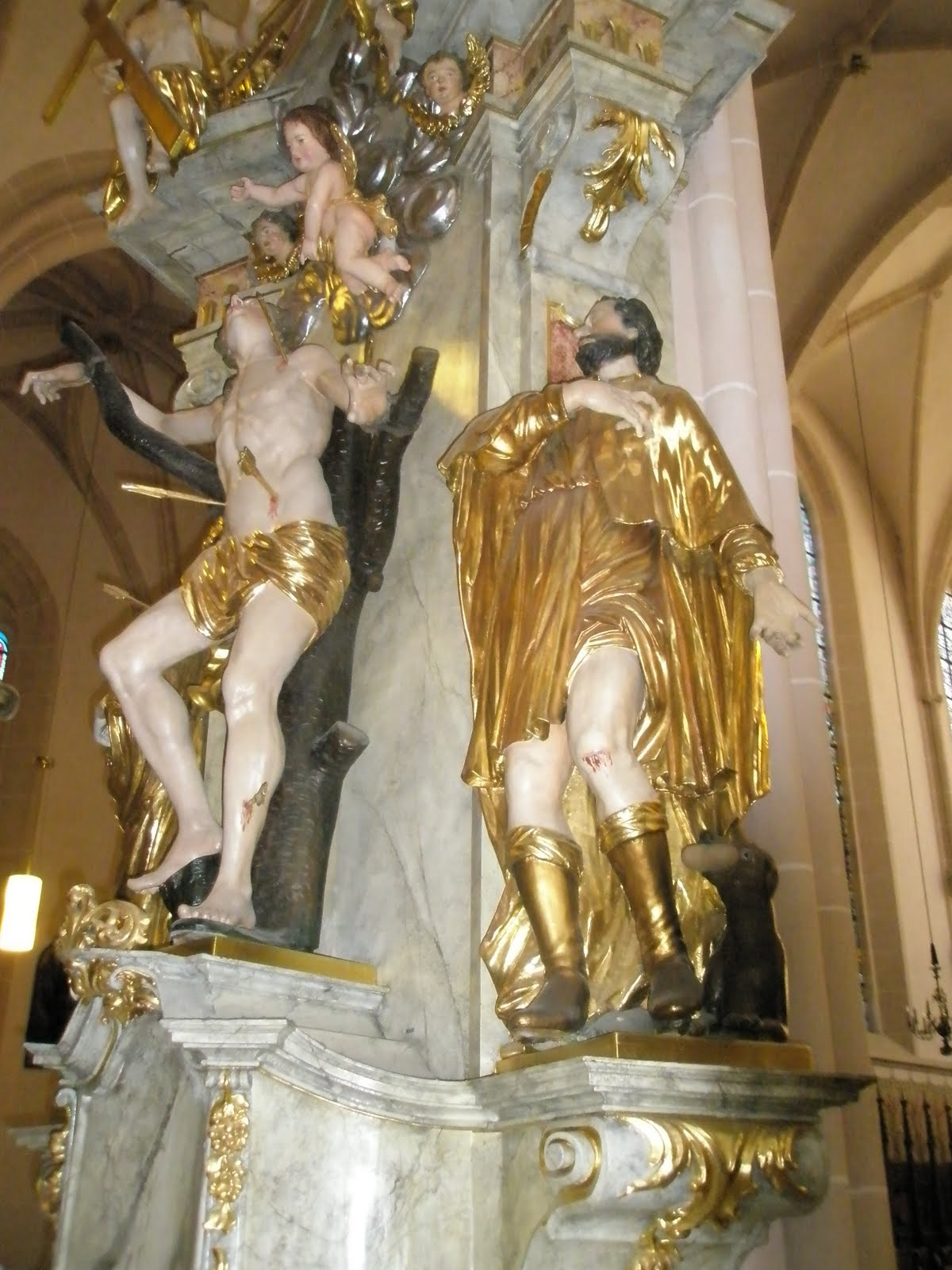
I just found two stray photos of St. Stephen's Church in Baden bei Wien. One is of the baroque-era plague saints (Sebastian and Rocco, note his dog in the lower right), and the other is of the organ that Mozart composed for. Same organ.